
By Hali Moore
Staff Writer
Under the lights in Ljubljana, Slovenia, the Swiss national team, a perennial B-Pool afterthought, stared down a Ukrainian squad of bigger, stronger, and more experienced athletes. Both teams entered the clash with unblemished 2-0 records at the 1994 European Baseball Championship (B-Pool), but only one was expected to leave with its perfect record intact.
What unfolded was a masterclass in strategy, trust, and the defiant spirit of an underdog, orchestrated by a 27-year-old American coach, executed by a 14-year-old pitching prodigy, and cemented by a 19-year-old catcher.
“It was, without question, the biggest game of my coaching career up to that point,” recalls Marvin “Merv” Moore, the Swiss National Team head coach.
“Ukraine was the tournament favorite. They were men, with sweet-swinging left-handed power hitters. During their batting practice, balls were flying over the fence in droves. We were supposed to be just another notch on their belt.”
Faced with this Goliath, Coach Moore made a radical decision. For the first time in his career, he would call every single pitch from the dugout, relaying signs to his catcher, Stefan “Sutti” Suter, who would then signal the young hurler on the mound.
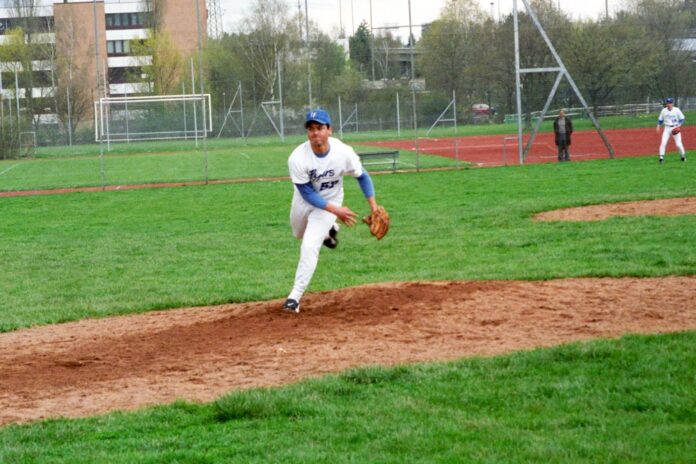
That pitcher was Allain Kurz—a stocky, quiet 14-year-old with a Swiss father and a South Korean mother, who had just weeks earlier been playing on the Therwil Flyers’ second team.
The audacity of the plan was matched only by its foundation. In Switzerland, where formal team practices were limited to evenings, international coaches like Moore had ample free time during the day. For months, he had invested those hours not in leisure, but in development. Every afternoon, after school, Allain and his friend Sebastian “Seppi” Zwyer, both just 12 years old at the time, would meet Moore at the field in Therwil.
“We had countless hours together on empty diamonds,” Moore explains. “That’s where the magic happened. I taught Allain how to spin the ball, how to throw curveballs at varying speeds. We worked on bouncing a curveball in the dirt with two strikes to make a hitter chase, and we paired it with a high fastball to induce weak pop-ups. He wasn’t just throwing; he was learning how to keep hitters off-balanced.”
This intensive, one-on-one apprenticeship was about to be tested on Europe’s biggest stage. The game plan was simple yet risky: feed the powerful Ukrainian lineup a steady diet of off-speed pitches. Allain’s curveball, a weapon forged in those solitary afternoon sessions, would be the key.
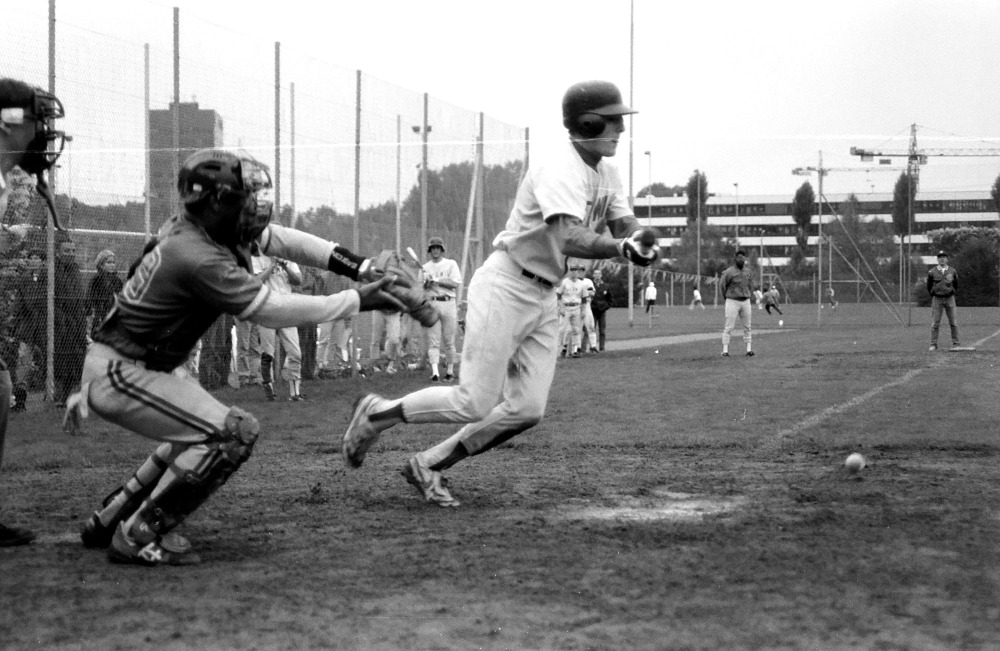
The strategy worked from the very first batter. “The leadoff hitter took two curveballs for strikes,” Moore says, a smile in his voice even decades later. “I knew right then they hated slow pitches. The kid inside me was getting excited.”
Switzerland scraped together a 2-0 lead in the second inning, but Ukraine clawed one back. Undeterred, Allain grew stronger as the game progressed, his quiet confidence permeating the team.
“He was a ‘special’ kid,” Moore emphasizes. “He wasn’t worried at all. The moment wasn’t too big for him.”
As Switzerland clung to a 4-2 lead entering the final inning, the pressure became palpable.
“You could see the strain on my players’ faces,” Moore recalls. “Some still didn’t believe we could win. I had to become a salesman.”
Channeling the energy of his coaching idol, NFL Hall-of-famer Jimmy Johnson, Moore was on top of the dugout, yelling, clapping, and injecting belief. In a huddle before the final three outs, he challenged his team: “We need three outs to prove that Swiss baseball wasn’t a joke anymore.”
Allain, however, had his own plan perfected. The relentless curveballs had slowed the Ukrainian hitters’ bats so effectively that Moore and Suter could now sneak in fastballs to induce foul balls. With two strikes, the Ukrainian batters were frozen—terrified of the high heat or the curveball that dove into the dirt at the last second.
Sponsored Links
The final out was an infield pop-up. Pandemonium, mixed with utter exhaustion, ensued. Moore was emotionally drained and hoarse. Across the field, stunned Ukrainian players sat in their dugout, while tournament officials frantically relayed the shocking result on their oversized cell phones.
For the first time in its history, the Swiss national baseball team stood atop a European Championship standings with a pristine 3-0 record. They had toppled a tournament giant with a teenager, a catcher, and a coach who dared to use his free time not for sipping espresso, but for building a future.
“Collecting Swiss League championships meant little to me,” Moore reflects. “But beating Ukraine and posting that 3-0 record at the European Championships meant everything. It was a statement. My training methods dominated Swiss baseball, but that was too easy. That day proved to me that I could train players that could compete well on the international stage.”
It was more than an upset; it was a revelation, born from afternoon sun on a empty field and executed under the bright lights of history.
“I know I can develop professional minor league prospects,” added Moore who turned down a chance to coach youth baseball at a Chinese Sports Academy in 2017.
“I would have went to China if my wife would have been able to join me, but life changes plans. God works in mysterious ways because I’ve been waiting my entire life for the type of opportunity that awaits me in Bohol.”
About the Bohol Coconuts Baseball & Softball Club:
Launching on March 1, 2026, and based in Barangay Cambanac, Baclayon, the Bohol Coconuts is a comprehensive sports and community organization offering youth and adult sports programming, academic and social activities, and affordable nutrition services through its soup kitchen and food store.