
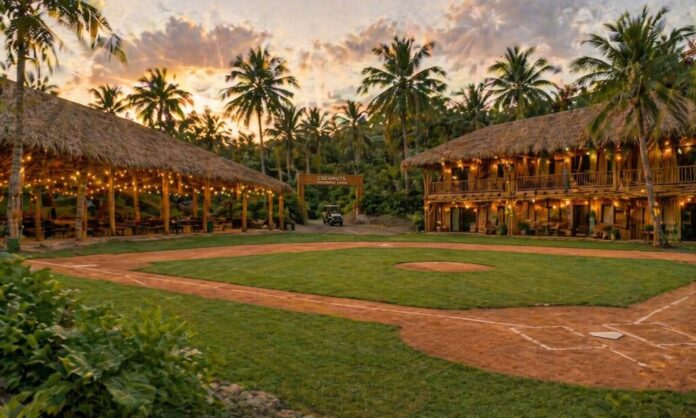

Building a high-performance sports facility is a feat of engineering in any corner of the globe. In the United States, project managers contend with zoning permits, supply chain delays, and labor unions. But on the island of Bohol, at the site of the future Coconuts Performance Center, the obstacles take on a much more primal character.
Here, the “supply chain” might be blocked by a water buffalo, and the “zoning permits” are often secondary to the whims of the tropical rainy season. Designing the home of the Bohol Coconuts Baseball & Softball Club isn’t just a construction project; it’s a daily battle against the elements, the terrain, and the unique logistics of the Philippine archipelago.
The Terrain: When the Earth Fights Back
In the U.S., a developer can usually expect a relatively predictable landscape once the initial survey is done. In the Central Visayas, however, the jungle is a living, breathing entity that resists being tamed.
“Back home, you clear a lot and it stays cleared for a while,” says Coach Merv Moore, the visionary behind the Coconuts. “Here, if you turn your back for a week, the jungle starts reclaiming the infield. We’re not just building a facility; we’re negotiating for space with nature.”

The soil composition adds another layer of complexity. Bohol is famous for its limestone “Chocolate Hills,” and that same geological makeup means the ground is either rock-hard during the dry season or a treacherous slurry of mud when the monsoons hit. Finding the right drainage solution for a professional-grade baseball diamond in a region that sees over 100 inches of rain a year requires more than just standard pipes.
Logistics at the End of the Road
For Coconuts General Manager Lerma Moore, a local politician and community liaison, the challenge often boils down to a single question: How do we get it here?
“People in the States are used to a truck arriving from a warehouse with everything they ordered,” Lerma explains. “For us, every bag of specialized clay and every piece of turf equipment often has to travel by planes, ships, and then by smaller trucks through winding jungle roads that weren’t exactly designed for heavy machinery.”
This “island logistics” creates a domino effect of delays. If a specific part for a tractor breaks, it isn’t a trip to the local hardware store. It might mean a four-day wait for a shipment from Manila or Cebu. “Patience isn’t just a virtue here,” Lerma adds. “It’s a requirement for survival.”
The “Humidity Tax” on Infrastructure
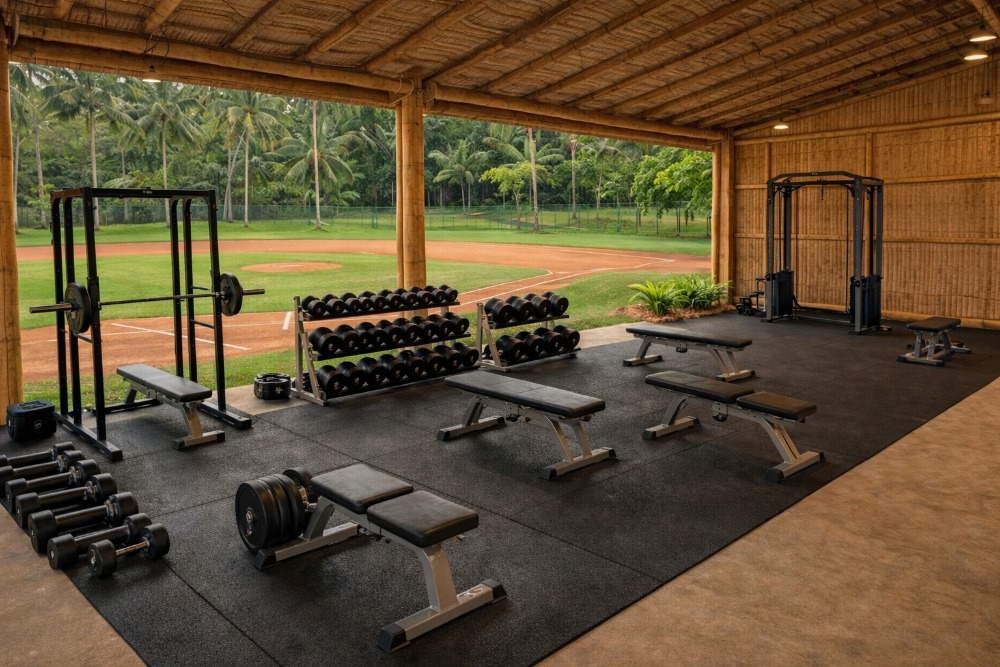
In a climate where the air is often as thick as the vegetation, traditional American building materials often fail. Metal rusts at an accelerated rate, and standard wood is an all-you-can-eat buffet for local termites.
Coach Merv emphasizes that the design of the Coconuts Performance Center has to account for this “Humidity Tax.” The facility utilizes open-air designs to maximize airflow, a necessity when training elite teenage prospects in 90-degree heat with 80% humidity.
“You can’t just build a big concrete box and crank the A/C,” Moore says. “It’s not sustainable, and it doesn’t prepare the athletes for the environment they’ll be playing in. We’re designing for ‘passive cooling’—using the natural island breeze. It’s an architectural challenge you just don’t face in a temperate climate.”
Power and Water: The Unreliable Grid
In the U.S., you flip a switch and the lights come on. In rural Bohol, the power grid can be as temperamental as a rookie pitcher.
“Brownouts are part of life,” Lerma notes. “When we’re designing the lights for evening practices or the power systems for the Coconuts Performance Center, we have to build in redundancy. We’re looking at solar arrays and backup generators just to ensure we can keep the pitching machines running and the water pumps active.”
Water management is equally critical. While there is plenty of rain, capturing and filtering it to meet the standards of a luxury Eco-Lodge and a high-performance training center requires an independent infrastructure. The facility must essentially function as its own utility company, a burden rarely placed on sports academies in the West.
Cultural Integration and the Human Element

Perhaps the most significant challenge—and the one Coach Merv is most passionate about—is ensuring the facility belongs to the community.
“You can’t just drop an American-style academy into a Filipino village and expect it to work,” says Moore. “The design has to reflect the local culture. We’re incorporating traditional Filipino aesthetic touches and ensuring the space is welcoming to the families of our players.”
Lerma agrees, noting that the labor itself is a collaborative effort. “The men and women helping us build this aren’t just contractors; they are the fathers and uncles of the kids who will be playing here. They have a stake in this. When we hit a challenge, like a road wash-out, they don’t just walk away. They find a way to fix it because this is for their kids future.”
A Movement, Not Just a Building
Despite the snakes, the mud, the heat, and the logistical nightmares, the vision for the Bohol Coconuts remains unshaken. The Coconuts Performance Center is designed to be a beacon of what is possible when international expertise meets local grit.

“Every time we overcome one of these ‘jungle challenges,’ it makes the project stronger,” Coach Merv concludes. “In the U.S., everything is streamlined, but it can also be sterile. Here, every brick laid and every blade of grass planted has a story of struggle and triumph behind it. We aren’t just building a training facility; we’re building a legacy that is as tough as the jungle itself.”
For those following the journey through the “Building the Coconuts” series, these challenges aren’t just obstacles—they are the proof that the path to developing the first Filipino MLB superstar is being forged with real sweat and island ingenuity.
To learn more about the project or to support the mission, visit the Founders Club – An exclusive collective of visionaries driving the future of elite teenage baseball and softball prospects on Bohol Island.