
The Man Who Traded Tokyo for a Dusty Diamond
Kenji Murakami had a corner office, a company car, and a retirement path mapped to the month. Then he watched a thirteen-year-old kid throw a curveball in the Philippine rain — and everything got complicated.
March 2029 · Bohol Island, Philippines
The pen trembled in Marco Villanueva’s hand. Not from nerves, exactly — more from the weight of understanding what the pen meant. At sixteen, Marco had a grip strong enough to snap the barrel of that cheap ballpoint, but he held it as if it were something borrowed. The lawyer slid the contract another inch closer. Marco looked up at the man standing beside his mother.
Kenji Murakami gave a small nod. Nothing theatrical. The kind of nod a man gives when the math he ran three years ago finally resolves to the right answer.
Marco signed.
The Texas Rangers representative shook hands down the line — Marco’s mother first, then his older brother, then the academy coaches, then Kenji. When Kenji’s hand came free, he slipped it into his trouser pocket and looked out the window of the conference room at the tarp-covered batting cage below, still wet from the morning rain. He did not say anything for a long time.
Later, someone asked him how it felt. He considered the question with the patience of a man who spent fifteen years leading quarterly reviews, and then he said: “Like compound interest. You can’t feel it happening. And then one day you can.”
Baseball in Bohol was not a business opportunity. It was, Kenji would later say, “a problem I could not stop thinking about.” There is a difference, and it matters.
— Kenji Murakami, Club President, Bohol Coconuts Baseball and Softball ClubDecember 2028 · Tagbilaran City
The call came to Kenji on a Tuesday evening, which was also a Wednesday morning in Tokyo, and the cruelty of time zones had long since stopped meaning anything to him. He was sitting in the academy’s small equipment room, cataloguing glove orders with a flashlight because the overhead bulb had blown again and no one had bought a replacement yet. This was, he reflected, extremely far from asset management.
His business partner, an American who had coached in Europe and Asia named Merv Moore, was on the other end of the call. The MLB club Texas Rangers wanted to schedule a formal evaluation for Marco. If it went well, the contract discussion could happen before the New Year.
“He’s ready,” Coach Merv said.
“He’ll be ready in April,” Kenji said.
“Kenji.”
“His mechanics on the breaking ball are still —”
“Kenji. He is ready. Let the scouts see what we have been building.”
There was a silence on the line. Kenji turned his flashlight off and sat in the dark among the batting helmets and the smell of leather. Outside, he could hear the ocean. That still surprised him, sometimes. He had worked three blocks from a highway overpass for over a decade, and now he could hear the ocean from work.
“Schedule it,” he said.
March 2026 · Tokyo, Japan
Kenji Murakami was forty-one years old and had recently been promoted to deputy general manager of the fixed-income division of a mid-sized Tokyo securities firm, and the timing of Coach Merv Moore’s email could not have been worse.
Coach Merv’s email was twelve hundred words and contained a spreadsheet. The spreadsheet outlined a five-year plan for a baseball development academy on Bohol Island. It was detailed, rigorous, and financially appealing. There was a line at the bottom that read: “I need someone who understands both the numbers and the game. I think that is you.”
Kenji read the email three times, forwarded the spreadsheet to no one, and drafted a polite decline.
He did not send it.
This bothered him. He was a sender of polite declines. He had sent them to startup pitches, to speaking invitations, to a cousin who wanted him to co-sign an apartment lease. The draft sat in his outbox for eleven days. His wife, Yuki, noticed he was quieter than usual. She asked if it was work.
“No,” he said. “Work is fine.”
“Then what?”
He showed her the email. She read it without expression, then read it again. Then she said: “You already want to do this.”
“That is not what I said.”
“You didn’t have to.”
ContextBaseball’s roots in the Philippines reach back to the American colonial era. Despite decades of uneven institutional support, the country has produced players who have appeared in Asian professional leagues. Development infrastructure, however, has historically lagged behind regional neighbors — a gap that private academies like the Bohol Coconuts are working to close.
June 2026 · Bohol Island, Philippines
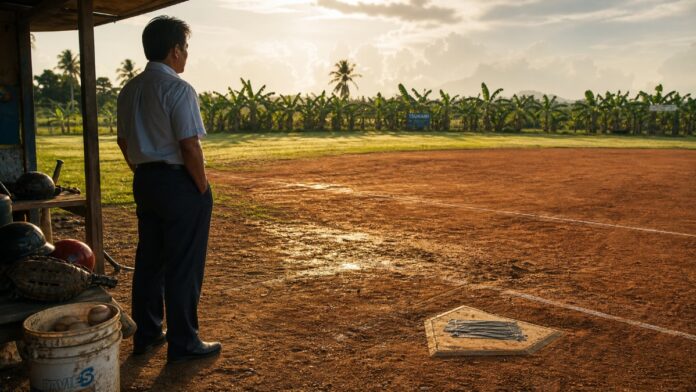
The tryout Coach Merv had arranged was held on a municipal field in Baclayon whose outfield fence was a row of banana trees and whose infield clay turned orange-brown in the afternoon heat. Forty-two boys showed up. Some had proper cleats. Most did not. One had wrapped athletic tape around the toes of his rubber sandals.
Kenji stood behind the backstop in the clothes he had worn on the plane — pressed slacks, a short-sleeve button-down, wholly incorrect for the occasion — and watched Coach Merv put the kids through drills with the efficiency of a man who had been doing this in his mind for years.
The boy in the sandals was Marco Villanueva. He was thirteen. He had a live arm and footwork that was instinctively correct despite never having been formally coached. When he threw, he threw with his whole body, not just his shoulder, and he landed on the ball of his foot every time. Kenji found himself making a note in the margins of Coach Merv’s spreadsheet.
On the flight back to Cebu, and then on the connecting flight to Manila, and then on the long overnight back to Narita, Kenji thought about compound interest. He thought about a thirteen-year-old in taped-up sandals who threw with his whole body. He thought about what it cost to build something and what it cost not to.
He landed in Tokyo at six in the morning. He took the Narita Express to the office. He called his wife from the lobby.
“I’m going to send the email,” he said.
“Which email?” Yuki asked, though she already knew.
“The one that says yes.”
He had no illusions that he was saving baseball or saving anyone. He had run the models. The academy had a promising YouTube reality docuseries and was building an Eco-Lodge that would provide steady revenue streams. Coach Merv was focused on youth baseball development and needed someone to direct the business operations. Kenji had no clue what the future held, but the challenge excited him.
— Bohol CoconutsMarch 2029 · Tagbilaran City
After the handshakes, after the paperwork, after Marco’s mother wept quietly into a tissue while his brother took photos on his phone, the conference room emptied in the way conference rooms do — quickly, and then completely.
Kenji walked down to the batting cage. The tarp was still damp. He pulled it back and looked at the rubber home plate, cracked slightly along one edge and repaired with dark electrical tape. They had been meaning to replace it since the first year. There had always been something else.
Coach Merv came down a few minutes later and stood beside him.
“He will be good,” Coach Merv said.
“I know.”
“There are five more. Maybe six. One year, maybe two.”
“I know that too.”
They stood there for a while in the particular quiet of a place where something has just been decided. The ocean was audible from where they stood. Somewhere in the building above them, Marco Villanueva was taking a photo of his signed contract to send to someone he loved.
Kenji pulled the tarp back over the plate and made a note in his phone: Replace home plate. This week.
Some things, he had learned, you stop putting off.