
The Man Who Would Not Stop Winning
Broken dreams, a shattered leg, championship titles on two continents, and a newspaper that rattled a college athletics department — Merv Moore has never done anything small. Now, approaching 60, he is building something extraordinary in Bohol.
There is a certain kind of man who arrives in a room and immediately begins rearranging the furniture — not out of arrogance, but because he cannot help seeing how things could be better.
Merv Moore is that man. He has been that man since he was 17 years old, a teenager in Seagoville, Texas, holding a clipboard and running a baseball dugout when most of his peers were still figuring out how to drive. And he has never really stopped.
Now, a few months shy of 60, Moore is at it again. This time the room is a baseball diamond in the Philippines, and the furniture he is rearranging is the Bohol Coconuts Baseball and Softball Club — a project he has poured himself into with the same combustible combination of vision, stubbornness, and competitive fury that has defined every chapter of a life that reads less like a resume and more like a novel.
“I’ve never met a challenge I didn’t think I could beat,” Moore said, the familiar conviction settling into his words. “That’s just how I’m wired.”
Moore grew up in Seagoville, a small city on the eastern edge of Dallas County, where baseball was more than a pastime — it was the organizing principle of his young life. He was good. Better than good, actually.
By the time he finished high school, he was one of the premier prep hitters in the Dallas-Fort Worth area, carrying a .479 batting average and a reputation as a contact hitter who just simply did not strikeout.
Batting in the three-hole, Moore was also nicknamed the ‘Human Vacuum Cleaner’ for his defensive prowess at third base. He had never, by his own account, met a pitcher he could not hit. Professional baseball was not a fantasy for Merv Moore. It was the plan.
It was also, as it turned out, a plan that life had no intention of honoring.
Three months after he graduated from high school, Moore underwent major leg surgery — the kind of operation that, in that era, did not just sideline athletes. It erased them.
“Back in those days, athletes who had major surgery were considered damaged goods,” Moore recalled.
All of my life I had dreamed of playing professional baseball because I had never met a pitcher that I couldn’t hit. When that dream died, playing baseball was not fun anymore. I was just going through the motions.
Merv MooreHe enrolled at Bethel University after missing two years recovering, and when he finally did return to the diamond he was a different version of himself — still capable, still disciplined enough to set a single-season team record with 103 at-bats and bat over .300 and earn Freshman of the Year honors, but hollowed out in the place where the fire had lived. The dream was gone, and he knew it.
What replaced it surprised even him.
To earn extra money at an expensive Christian college, Moore started writing sports articles for the student newspaper. The pay was $25 per piece — modest by any measure, but it lit something.
“It was easy money for a sports fanatic,” he said, “and my life finally had direction again.”
That direction accelerated fast. Moore became sports editor in his second year. By his third year, he had been promoted to editor-in-chief of The Clarion — becoming the first African American to hold that position in the publication’s history. The trailblazing had begun in earnest.
But it was not the title that defined that chapter. It was what he did with it.
As sports editor, Moore wrote a three-part investigative series titled “Bethel Athletics: Why Can’t We Win” — a front-page examination of the university’s athletic programs that was neither polite nor deferential. It was the work of someone who understood that journalism, done right, has consequences.
The powerful series, which included interviews with rival athletic directors, landed with enough force that the head football coach was dismissed following that season. The head basketball coach, who also served as athletic director, was relieved of his administrative duties. A student with a notepad had moved an institution.
Moore landed his first professional journalism job in 1989 at The Houston County Courier, a bi-weekly newspaper where he covered five high school athletic programs as sports editor. The Texas Gulf Coast Press Association recognized his work in 1990. He was 23 years old and already collecting honors.
But the gravitational pull of home was strong. After 13 months, he resigned and returned to Seagoville to start his own newspaper, The Seagoville Gazette. The paper quickly became the dominant publication in the area. By every external measure, he was thriving. Internally, it was a different story.
“I was not happy and I missed baseball,” Moore recalled. The grind of 80-hour weeks and the solitude of being married to a business with no personal life had taken their toll.
The former All-District standout had coached teenagers in East Texas and Seagoville, a semi-pro squad in Dallas, and had won championships everywhere he went. Coaching came easy to him.
However, coaching in the American framework felt limiting — high school programs and entry-level college assistant positions held no appeal for a man who had already proven he could build winners from scratch.
“I was never interested in being a teacher and high school baseball coach,” he said, “and starting at the bottom of the college ranks as an assistant coach at some small university was not appealing either.”
So he sold the business. And he left the country.
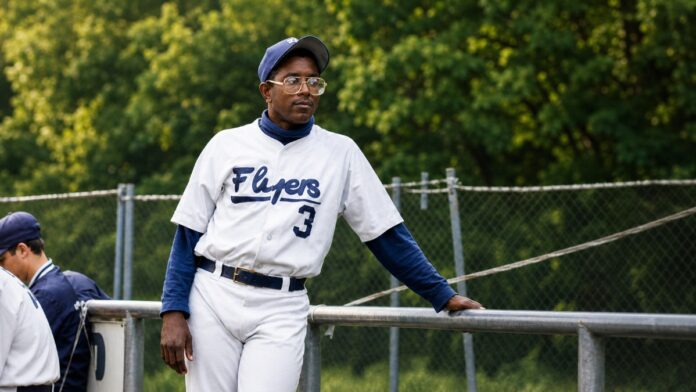
Moore landed with the Therwil Flyers, Switzerland’s largest baseball and softball club. What he inherited was a team with credentials — back-to-back Swiss championships under former Cuban national team manager Juan Vistuer Valdez — but a reputation that did not quite match the trophy case.
“The Flyers were known in Swiss baseball circles as a paper champion, a side that could be beaten by any league squad on a given day.”
That perception did not survive his first season.
In his debut campaign, the Flyers went 27-2, including a perfect 21-0 record on Swiss soil. Over his first two seasons, Therwil posted 55 wins in 61 games.
Therwil did not just win Swiss championships — they collected them consecutively, three in a row, and they did so with a brand of baseball that forced every other club in the country to reckon with what a properly organized, relentlessly coached team could look like.
Swiss baseball was a joke when I arrived. That’s why I did not want to just win — I wanted to dominate.
Merv MooreThe dominance was occasionally theatrical. During the 1994 Swiss League championship series, with his team comfortably ahead, Moore replaced his entire starting lineup in the fourth inning with a group of teenagers aged 15 to 17. It was not recklessness. It was message-sending.
“We were developing players and I was confident that my young guys could compete,” he said. “Psychologically, that move deflated the opposing team.”
The success in Switzerland opened a door in the United States. Moore returned stateside to manage the Dallas MudCats in the Texas Rookie League, a professional venture that looked promising until the ownership group ran out of money after just three months of operations.
“I was devastated,” he recalled. “I trusted some individuals who were good salesmen, but awful businessmen.”
It was a bruising experience. But fate, as it often does with Moore, intervened on schedule. A phone call came from Switzerland.
The Therwil Flyers — who had replaced him with a new American coach during his absence — were in trouble. They were sitting in third place, having lost their edge and their championship identity. The team Moore had built was drifting. They wanted him back.
But the return to Switzerland came with a wrinkle. The Geneva Hound Dogs, recently promoted from the second division and stocked with a starting nine of six Latino players with Swiss passports, two Americans with Swiss passports, and one Swiss national, were dominating the league. And the Flyers had fallen behind them.
Moore accepted the challenge and engineered what may be the most dramatic moment of his coaching career.
Although Therwil lost Game 1 of the Swiss Finals to Geneva, he led the Flyers back to win the title — a championship he claims against a team with, by his own honest reckoning, significantly superior talent.
“That was the hardest championship because the Hound Dogs had significantly more talent than my team, which had eight Swiss players and a 40-year-old Guatemalan first baseman.”
Moore returned in 1996 and guided the Flyers to the championship series again. But something had shifted in the culture. Sustained success had turned hungry players complacent. The Flyers believed they could win with any coach.
“Too much winning took its toll on most of the players, who became arrogant and took winning for granted,” Moore said. They lost in the Finals for the first time. Moore decided it was time for a new challenge.
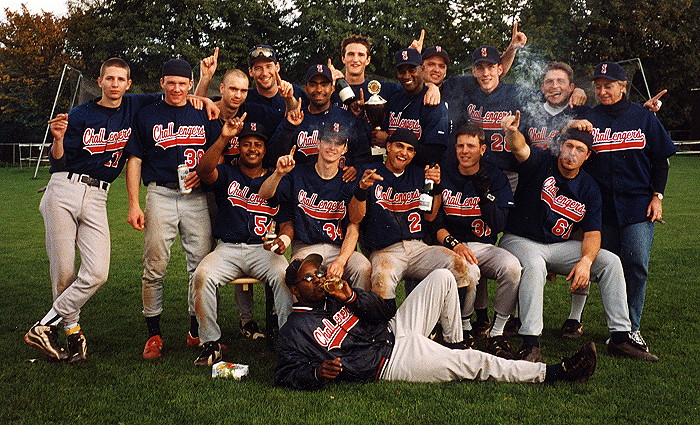
He moved to Zurich to take over the fifth-place Challengers.
What followed was, by his own assessment, his finest season as a manager — despite never reaching the championship series.
Despite one of his top players being unavailable for road games and training sessions due to mandatory military service, limiting him to home games only, the squad that Therwil swept in the season opener finished the regular season as a legitimate title contender.
Moore himself was suspended for the first playoff game after being ejected during a regular season game. Still, the Challengers built a nine-run lead over Therwil in Game 1 of the semifinals before ultimately surrendering the lead and the game.
Moore returned for Game 2, the Challengers won, and a winner-take-all Game 3 went to Therwil behind the league’s top pitcher.
“No way we lose the first game if I was coaching,” Moore said, the old competitive flame still burning hot decades later. “We would have swept my former team and advanced to the finals.”
The 1998 season was his final one in Switzerland, and he left with authority. The Challengers dominated the league as Moore claimed his fourth Swiss League title in commanding fashion. It was a proper goodbye.
The club-level success was significant. But Moore counts the transformation of the Swiss national team among his proudest professional achievements — and he came to it in the most Merv Moore way possible: by watching something embarrass itself and deciding he could fix it.
“The first time I saw the Swiss national team, I was embarrassed,” he said. “The team was so bad that I had actually stopped coaching first base after three innings because the Swiss struggled to hit the ball out of the infield.”
Several months later, the national team’s American head coach was fired. Moore took over.
When Switzerland arrived in Ljubljana, Slovenia for the 1994 European Championship B-Pool tournament, they brought three pitchers and just one previous win in international tournament history. What they produced was historic.
The Swiss started the tourney with three straight wins, including a 4-2 victory over eventual tournament champion Ukraine — achieved, remarkably, behind a 14-year-old pitcher.
“The victory over Ukraine was bittersweet,” Moore said, “because while we were in first place after three games, I had no pitching left.” The Swiss finished 3-3, but the direction had been established.
The 1998 European Championship B-Pool tournament in Vienna, Austria arrived under difficult circumstances — a divided Swiss Baseball and Softball Association had failed to fund the team for the 1996 event.
Moore traveled to Austria without four of Switzerland’s top players. Still, the Swiss advanced to a semifinal against Croatia, whose roster featured two American collegiate pitchers holding Croatian passports.
Switzerland lost 4-3. It is a result Moore has never fully made peace with.
“I started Ueli von Burg at second base because I was anticipating a close contest,” he said. “But in hindsight, I should have started Gary Kochlefl because we only had four hitters that I trusted.”
The loss prevented Switzerland from playing in a game that could have promoted the nation to the A-Pool — a stage alongside European powers from Italy, Spain, and the Netherlands.
I was emotionally drained and devastated because I knew I was leaving Switzerland for good after the season. We were so close despite missing some of the Swiss League’s top hitters.
Merv MooreMoore is not a man who second-guesses himself often. But that lineup card from Vienna has stayed with him.
The numbers tell their own story about what Moore meant to the Flyers. After he departed Therwil, the club waited seven years before winning another league championship. And it would take them 18 seasons to equal the three national titles Moore had delivered in just four years.
The dynasty he built did not simply fade — it became the standard against which every subsequent Therwil era would be measured.
The legacy Moore left in Swiss baseball is not a subtle one. When he arrived, the sport was an afterthought. When he departed, clubs across the country were hiring foreign coaches, overhauling their development systems, and approaching baseball as something more serious than recreation.
The Texan believes the Flyers’ dominance made that shift inevitable.
“I truly believe the Flyers elevated the level of Swiss baseball because we were so dominant that clubs had to get serious and not just play baseball as a recreational sport.”
From the youngest head baseball coach in the history of the Seagoville Sports Association at age 17, to the first African American editor-in-chief of The Clarion, to four Swiss League championships, to leading a national team with three pitchers to a 3-0 start in international competition — the arc of Merv Moore’s life is one of persistent, occasionally improbable achievement.
The self-described “baseball addict” has broken barriers not by announcing his intention to break them, but simply by moving forward when others expected him to stop.
Now the Bohol Coconuts Baseball and Softball Club is the next frontier. Moore is approaching 60 years old, and if the history of the man is any indication, that number means nothing to him.
The veteran freelance sportswriter has never operated on anyone else’s timeline. He has never accepted someone else’s ceiling. He has always found a way to make the scoreboard read the way he intended it to read.
The Philippines is a new room. The furniture, as always, is already being rearranged.