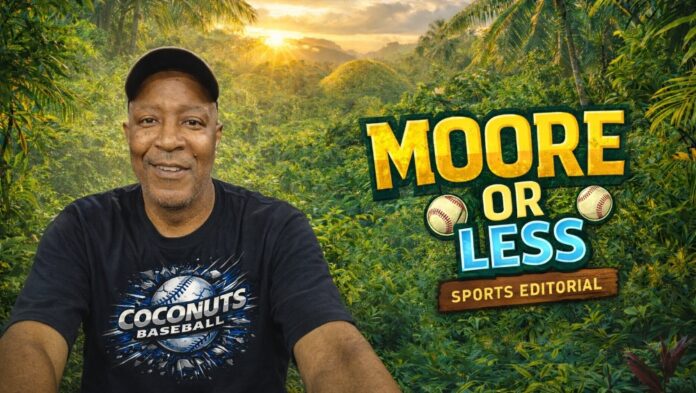

By Merv Moore
Sports Director & Head Baseball Coach
I want to talk directly to you for a minute.
Not to the sponsors. Not to the investors. Not to the baseball community that already knows my name or has followed this mission from the beginning. I’m talking to you — Filipino boys and girls sitting in a province somewhere, maybe on Bohol, maybe on an island I’ve never set foot on, reading this on a cracked phone screen with spotty signal and a head full of dreams you’ve never said out loud because you’re not sure you’re allowed to have them.
This one is for you.
When “Building the Coconuts” launches on YouTube on May 25, you’re going to watch a show about baseball and construction and a jungle that fights back every single day. You’re going to see a family under pressure, a team trying to build something in a place where the odds are stacked against them, and a dream being assembled one impossible decision at a time.
But here is what I need you to understand before you watch a single frame of it: this show is not really about any of that.
It’s about you.
The Lie You’ve Been Told
Somewhere along the way — in school, in your neighborhood, maybe even inside your own home — someone planted a quiet, poisonous idea in your mind. They didn’t say it out loud, necessarily. They didn’t have to. The message was delivered in subtler ways. In the sports programs that never came to your barangay. In the coaches who told you to be “realistic.” In the world-class facilities you saw on television that existed somewhere else, for someone else, for kids who were born into circumstances you weren’t.

The message was this: dreams that size aren’t built here. Not in a place like this. Not by people like us.
I’ve spent my entire coaching career — from the Swiss Alps to the mountains of Bhutan, from European club baseball to the mountains of Bohol — watching that lie destroy more potential than any injury, any poverty, any opponent ever could. And I’m tired of it.
So let me tell you something true, and I need you to hear it as clearly as I can say it:
Who your parents are and where you’re from is not a ceiling. It’s a foundation.
What does “Don’t Be Good. Be Great!” Mean?
That’s our motto at the Bohol Coconuts. You’ll see it on our website, on our gear, at the end of every editorial I write. Some people read it as a coaching slogan. A rallying cry. Something to put on a banner and photograph.
It’s not. It’s a conviction.
Good is what happens when you meet expectations. Great is what happens when you refuse to let anyone else set them for you. Good is the kid who shows up. Great is the kid who shows up, does the work while no one is watching, and then comes back the next day and does it again. Good is comfortable. Great is the decision you make at the exact moment when comfortable is available and you choose the harder path anyway.

I don’t teach “good” because “good” doesn’t change anything. Good doesn’t send the first native-born Filipino to the Major Leagues. Good doesn’t build a world-class performance center in the mountains of Bohol. Good doesn’t make a show that the world watches and says: wait — that’s happening there? With those kids? Under those conditions?
Only great does that.
And great — and this is the part no one tells you — is not reserved for the kids who were born in the right city, into the right family, with the right last name. Great is a standard. And standards are available to anyone willing to meet them.
Why the Cameras will Roll on the Hard Days
A lot of people have asked me why we’re doing a reality docuseries. Why put cameras on the delays, the setbacks, the days the jungle wins, the moments where it looks like nothing is going according to plan?
Here’s the real answer: because I want you to see that.
I want you to watch what happens when Coach Merv Moore hits a wall — and keeps going. I want you to see Lerma Moore hold this mission together with grace and grit when lesser people would have walked. I want you to see Rogelio on the construction site, Diosdado in the office, Hali and SJ living inside a dream that hasn’t fully arrived yet and refusing to flinch.
I want you to see all of it because the world has fed you a very specific kind of success story for a very long time. The kind where everything goes smoothly, where the right people appear at the right moment, where the obstacles are merely plot points on the way to a clean, triumphant ending.

Real life doesn’t look like that. Real building doesn’t look like that. And real greatness? It absolutely does not look like that.
What will the “Building the Coconuts” series look like? Messy. Exhausting. Expensive in ways that go beyond money. And worth every single day of it.
The First Filipino MLB Superstar Is Out There Right Now
I mean this literally. I believe with everything I have that the first native-born Filipino Major League Baseball superstar is alive right now. Probably in a province. Probably playing on a field that doesn’t look like much, with equipment that’s seen better days, in a uniform that doesn’t match.
And probably — if we’re being honest — probably doubting whether any of this leads anywhere real.
That kid is who the Coconuts Performance Center is being built for. That kid is who “Building the Coconuts” is being filmed for. That kid is who I’ve been working 18-hour days for, negotiating sponsorships for, recruiting the investors for, putting my family through the pressure cooker for.
If there is any chance — any chance at all — that watching this series puts something in that kid’s chest that wasn’t there before. A spark. A stubbornness. A refusal to accept that the ceiling someone else painted is permanent. Then every obstacle we’ve faced in making it was worth it.

Because here’s what I know after a lifetime of coaching: you cannot dream your way to greatness. But you also cannot reach greatness without first believing the dream belongs to you.
This show is permission. Permission to want more. Permission to work harder than anyone around you thinks is necessary. Permission to look at a muddy construction site in the mountains of Bohol and see a world-class facility, because you have trained yourself to see what isn’t there yet — and then build it anyway.
What I’m Asking You to Do
Watch the show on May 25. Watch it and pay attention — not just to the baseball, not just to the construction, but to the decision-making. Watch what happens when you refuse to let a setback become a surrender.
Then ask yourself one question: If they can build that there, what can I build here?
The answer to that question is the whole point.

We aren’t just building a baseball club. We aren’t just building a performance center or an eco-lodge or a YouTube channel. We are building proof — visible, documented, 24/7 on-camera proof — that “this” is possible. That here is enough. That you are enough — provided you are willing to stop being good and demand greatness from yourself instead.
That’s the show. That’s the mission. That’s what I want every Filipino kid to take from it.
Don’t Be Good. Be Great.