

Breaking the cycle in Bohol
In Bohol, as in most of the Philippines, the family you are born into determines nearly everything about the life you will live. A business and social case for why the Bohol Coconuts model, built around baseball, academics, and trade school pathways, is one of the few mechanisms that can actually break that cycle for kids who never got to choose their starting point.
There is a phrase Filipinos use so casually that its weight can slip past you: kilala mo ba ang pamilya niya? Do you know his family? It sounds like small talk. It is not small talk. It is a door being opened or closed.
In the province of Bohol, and in hundreds of towns like it across the archipelago, that question decides who gets the job, who gets the loan, who gets the land, and whose children get the referral letter that puts them in front of someone who matters.
If you are born into the right surname, the architecture of opportunity assembles itself around you with quiet efficiency. If you are not, you begin a life of explaining yourself to rooms that were built before you arrived.
The Bohol Coconuts Baseball and Softball Club was not founded as a charity. It was not founded as a feelings project. It was founded on a very specific and unsentimental belief: that a structured, disciplined athletic environment, wired directly to academic support and vocational training, is one of the few mechanisms in the Philippine context that can create credible opportunity for young people whose surnames carry no weight.
The question the Coconuts are asking is not “can we help poor kids play baseball?” The question is more unsettling and more interesting than that: can sport, designed with enough intentionality, function as social infrastructure?
The social science literature on intergenerational mobility in Southeast Asia is, depending on your temperament, either clarifying or depressing.
Research consistently shows that in societies with high concentrations of family-based capital, including land, business networks, political alliances, and social trust, formal credentials alone cannot reliably separate a young person from their origins.
A diploma from a provincial college gets you to the interview. The surname gets you the job. Social capital in the Philippines is not metaphorical. It is transactional, inherited, and in many communities, effectively non-transferable across class lines by any conventional means.
What sport does differently, and what baseball in particular does when it is structured correctly, is create a parallel credentialing system. Not a replacement for education, and not a fantasy about athletic glory, but a framework in which a young person can build a public identity that is demonstrably theirs.
A fielding average, a grade point, a completed TESDA certificate: these are records that exist independently of family name. They are verifiable. They travel. In a context where the primary barrier to mobility is not ability but legibility, the ability to be seen clearly by institutions that did not know your grandfather carries real economic value.
We are not building a baseball team. We are building a track record. Every kid who comes through this program leaves with something that belongs to them and that no one can take back. That is the point.
Lerma Moore — General Manager, Bohol Coconuts & Cambanac Kagawad
Lerma Moore’s framing is precise and worth sitting with. The word “track record” is doing a great deal of work in that sentence. Track records are institutional. They survive the end of any single relationship. They can be presented to an employer in Tagbilaran, a recruiter in Manila, a TESDA assessor in Cebu, or an overseas employer processing an OFW application.
The families that already possess social capital understand this instinctively; they have been building and deploying track records for generations through connections the average Boholano family simply does not have access to. What the Coconuts are proposing is that sport, built with academic and vocational scaffolding, can manufacture that same kind of documented, transportable credibility from scratch.
Bohol is a first-class province with a growing tourism economy and a pronounced gap between families positioned to benefit from that growth and those who are not.
The provincial economy rewards land ownership, family-run hospitality businesses, and English-language proficiency. None of these advantages are randomly distributed. The Bohol Coconuts are launching in this specific context, not despite the inequality but precisely because of it.
A reasonable person might ask why baseball. Basketball dominates Philippine recreational life so completely that every barangay in the country has a court, most of them crumbling in beautiful and characterful ways.
Volleyball fills the spaces basketball does not. Baseball, by contrast, is a minority sport in the Philippines, practiced seriously in only a handful of provinces and urban centers. If the goal is access and reach, why build around the harder sport?
The answer, from a program design standpoint, is that baseball’s difficulty is not a bug. It is a structural feature. Baseball requires equipment, which filters out casual participation and creates an immediate marker of organizational seriousness when a club provides that equipment without charge to youth participants.
Baseball and softball requires sustained individual skill development within a team context, which is more cognitively demanding than sports that can be played reasonably well by beginners almost immediately.
These two sports also have a documented development pathway from youth to collegiate to professional, including a clear international dimension through the Southeast Asian Games and the World Baseball Classic qualifying structure, that creates genuine aspirational range.
And in Bohol specifically, it is not yet owned by any existing social hierarchy. The baseball court is, at this moment, genuinely level.
The sport demands individual accountability within a team structure: every at-bat, every fielding play, every decision on the basepaths is recorded. No one can hide inside a baseball game. That accountability, built into the sport’s DNA, is exactly the discipline that transfers to the classroom and the worksite.
The Coconuts model holds academic standing as a non-negotiable participation requirement. This is not window dressing. It means that every parent, teacher, and child in the program understands that the sport is a vehicle, not the destination. The credential structure is designed to survive the athletic career.
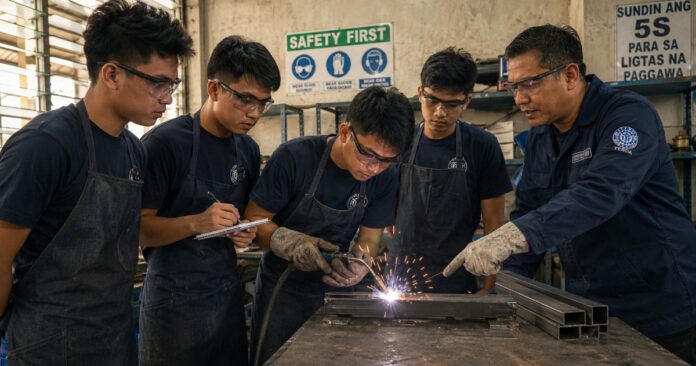
The third leg of the model is vocational. TESDA certification in skilled trades, electricity, welding, automotive, and construction technology creates employment pathways that do not depend on a university degree. For families that cannot afford four years of college, this is not a consolation prize. It is a practical route to a middle-class income.
The Coconuts draw from barangay-level youth populations with no prerequisite for prior athletic experience, economic standing, or family connections. Entry is structured around effort and conduct, not background. This is a deliberate design choice that signals to the community what the program actually values.
Athletic training and academic support run in parallel from the beginning. Neither is positioned as more important than the other. Youth participants develop the understanding early that excellence in both domains is the standard, not an aspiration.
As players mature through the program, TESDA vocational certifications become available alongside continued athletic development. For players with the aptitude and desire to pursue it, collegiate and national team pathways are tracked and facilitated. No child is pushed toward a single outcome.
The Coconuts are not an extract-and-export model. The goal is not to identify talent and funnel it out of Bohol toward Manila or abroad. The goal is to develop people who can contribute to Bohol’s own economy, social fabric, and next generation of youth programs. Alumni are potential coaches, administrators, and funders.
It would be a mistake to read the Bohol Coconuts purely as a social welfare intervention. The business dimension is real and worth taking seriously.
Bohol’s tourism sector is undersupplied with credentialed tradespeople, hospitality workers, and technical staff. The province’s growth has consistently outpaced its workforce development infrastructure.
A program that produces certified electricians, welders, and hospitality technicians from the provincial youth population is, among other things, solving a labor market problem that is currently being addressed either by importing workers from other provinces or leaving positions unfilled.
There is also a sponsorship and investment logic. In a market where corporate social responsibility spending is increasingly scrutinized for actual community impact rather than photography-friendly charity events, a program with measurable outcomes, academic records, credential attainment rates, and employment tracking is an unusually legible investment.
The Coconuts are building a model that can produce the kind of documented outcomes that justify sustained private sector support, not as charity but as community development infrastructure with verifiable returns.
In Bohol, if you want a skilled tradesperson you trust, you call someone your family already knows. We want to change that. We want to be the institution that families trust, regardless of whether they already know us.
Lerma Moore — General Manager, Bohol Coconuts & Cambanac Kagawad
The framing Lerma Moore offers here is significant because it describes something more ambitious than a sports program and more sustainable than a charity. It describes an institution.
Institutions earn trust slowly, through repeated delivery on their promises, through the accumulated credibility of their members and alumni, through the slow displacement of the question “kilala mo ba ang pamilya niya?” with a different question: “Did they go through the Coconuts?” That second question, once it carries weight in Bohol’s employment and social networks, is the whole game. That is when a surname stops being the ceiling.
None of this is fast. None of this is guaranteed. Building a credible institution in a provincial Philippine context, against the grain of family-network social capital, is a project measured in decades rather than seasons.
The Bohol Coconuts are launching in June 2026. The first generation of young people entering this program will become the evidence on which all future judgments about the model rest. They did not choose their starting point. The Coconuts are betting that with the right structure, the right values, and the stubborn refusal to accept that a surname should determine a life, that starting point does not have to be the story.