

This is a sponsored post. The Bohol Coconuts Baseball and Softball Club may receive a commission for qualifying purchases made through the link in this article. This does not influence our editorial standards.
The Day the Supreme Court Made the President a King
A powerful new book by Merv Moore explains the ruling that changed the relationship between the American presidency and the law, and why every citizen should be alarmed.
The Ruling Nobody Fully Explained to You
On July 1, 2024, the Supreme Court of the United States handed down a decision that would have been unthinkable to every previous generation of Americans.
The case was Trump v. United States. The vote was six to three. Every justice in the majority was appointed by a Republican president.
The ruling held that a president enjoys sweeping immunity from criminal prosecution for actions taken in his official capacity. For the first time in the history of the republic, the Court declared that the occupant of the Oval Office stands apart from the criminal law that governs every other citizen.
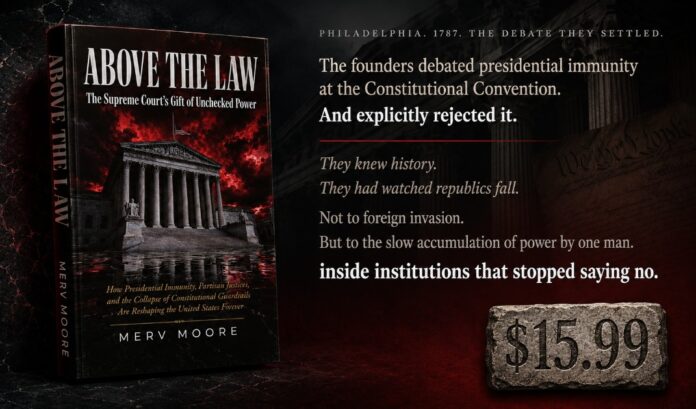
Merv Moore’s new paperback, “Above the Law: The Supreme Court’s Gift of Unchecked Power and the End of American Democracy as We Knew It,” is the most thorough, readable, and urgent account of what that ruling actually means for the country you thought you lived in.
What the Court Actually Said
Moore walks readers through the architecture of immunity the Court constructed, and it is more alarming than most headlines conveyed.
The justices divided presidential conduct into categories. Actions within the president’s core constitutional powers, including pardons, military commands, and appointments, receive absolute immunity. No balancing test. No inquiry into motive. No exception for corruption or abuse.
Under this framework, a pardon granted in exchange for a bribe cannot be prosecuted as a corrupt act, because the pardon power belongs exclusively to the president. The bribe might theoretically be prosecutable. The corrupt act itself is beyond the law.
Moore writes with controlled fury and meticulous sourcing. He does not ask you to take his word for it. He walks you through the actual language of the opinion and asks you to read it yourself.
A Warning Written Centuries Ago
One of the most powerful sections of the book traces the founders’ own fears about executive power. They had read their history. They understood that republics are fragile, that power accumulates, and that no system survives a leader willing to exploit every available vulnerability.
So they built guardrails. They constructed overlapping systems of accountability. They designed a presidency of limited powers, subject like every other citizen to the law.
Moore measures those original intentions against the constitutional reality of 2024 and finds a gap that should frighten anyone who loves this country.
The Roman Republic did not fall in a single day. It fell across decades as norms were bent, then broken, then forgotten. The foreword to Moore’s book, written by an anonymous former United States District Judge, draws that parallel with devastating clarity.
The Pay-for-Play Presidency
Moore devotes several chapters to the concrete ways a president can now use the office for personal enrichment without meaningful criminal exposure.
The pardon power can become a transactional economy. Federal contracts can be steered toward loyalists. Regulatory decisions can reward allies and punish enemies. The immunity ruling does not just protect past conduct. It provides a legal architecture for future abuse.
This is not speculation. Moore documents the pattern with court filings, congressional testimony, investigative reporting, and historical scholarship.
Congress Has Left the Building
The checks and balances the founders designed depend on Congress serving as a coequal branch of government willing to exercise oversight. Moore argues that Congress has largely abandoned that role.
What remains is a presidency with powers the founders never imagined, stripped of the criminal accountability that was supposed to restrain those powers, overseen by a Supreme Court whose conservative majority has demonstrated a striking alignment with one political party.
Why This Book Belongs in Every Home
Above the Law is not a book about one political figure. Moore is explicit about this. The structures being built will remain in place long after the current occupants of power have departed. A future president of any party will inherit the same immunities, the same expanded powers, the same neutered oversight.
The question is not whether you trust the person currently in office. The question is whether a system that places the president above the law can survive a leader willing to test every limit.
Moore believes clear-eyed awareness is the precondition for meaningful action. This book provides that awareness in full.